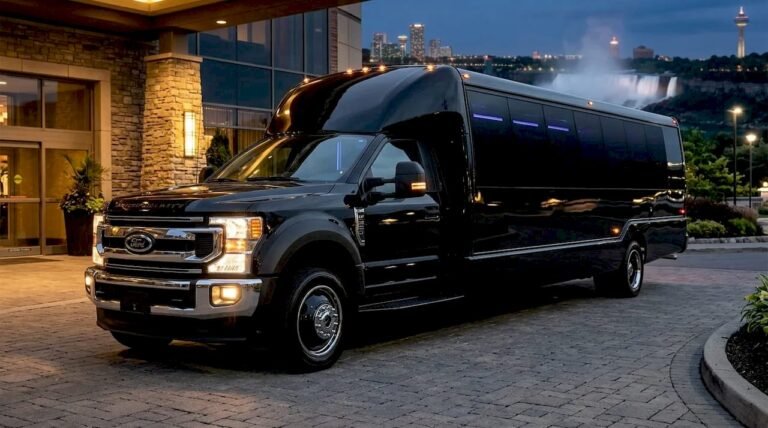


Corporate Event Transportation: How to Plan It Well
Corporate event transportation works when one party owns the whole movement plan: who travels, from where, when, in what vehicle, and what happens if something slips. Match the vehicle to the group size, build the schedule around arrival and start times rather than the other way around, confirm every detail in writing, and keep a backup chauffeur and vehicle plan. Below is how we approach it for events in Niagara Falls, Niagara-on-the-Lake and Toronto.
TL;DR
-
Choose vehicles by headcount, luggage and schedule: executive sedans and SUVs for leadership, Sprinter vans for mid-size teams, coach buses for large groups.
-
Confirm flight numbers, pickup points, venue access and a single on-site contact before the day, not on it.
-
For cross-border guests, check entry documents early. Visitors who need an eTA must apply online before flying to Canada.
-
Build buffers into every leg and agree a backup plan with your transportation provider in advance.
-
Request a tailored quote early, since group size, hours and route shape the price.
Table of Contents
What corporate event transportation actually covers
The phrase sounds like one thing, but it is usually four separate jobs bundled together:
-
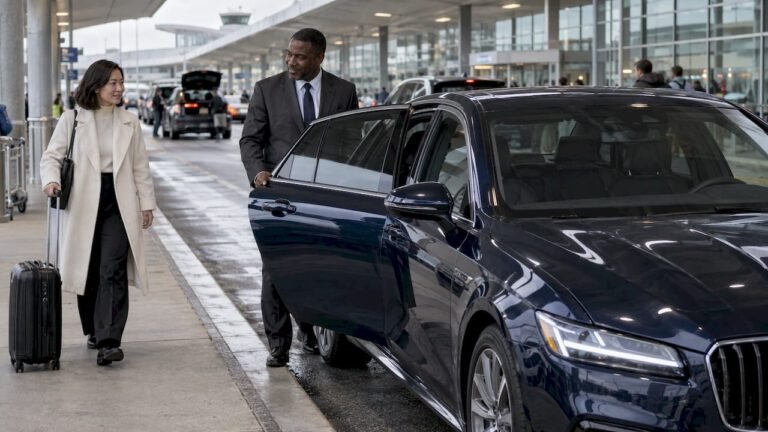
Arrivals and departures. Airport pickups and drop-offs for executives, speakers and attendees.
-
Hotel-to-venue movement. Getting people from where they sleep to where the meeting, conference or dinner happens.
-
Day-of movement. Site visits, client dinners, offsite activities, winery visits or team outings.
-
VIP and executive travel. Private, discreet transport for people whose time is the most expensive thing in the room.
Each job has a different best vehicle and a different failure mode. Arrivals fail on timing. Hotel-to-venue fails on loading and frequency. Executive travel fails when the car is late or the chauffeur does not know the area. Planning them separately, then joining them in one schedule, is what keeps an event calm.
In the Niagara region and Toronto, the typical corporate programs we see described by organizers fall into a few types: a conference or meeting in Toronto with airport arrivals, an executive visit to Niagara Falls with a dinner or tour, a team outing to Niagara-on-the-Lake wine country, or a client entertainment evening. Our corporate travel and cross-border service is built around exactly these.
Choosing the right vehicle for your group
Start with the number of people, then add luggage and schedule. Seats are only part of the answer: a sedan that technically seats three is not comfortable for three executives with carry-on cases and laptops.
| Group | Suggested vehicle | Best for |
|---|---|---|
| 1 to 3 people | Executive sedan | Executives, speakers, one-to-one client travel |
| 3 to 6 people, more luggage | Executive SUV | Small leadership groups, airport arrivals with bags |
| Mid-size teams | Sprinter van | Team transfers, offsite days, shared airport pickups |
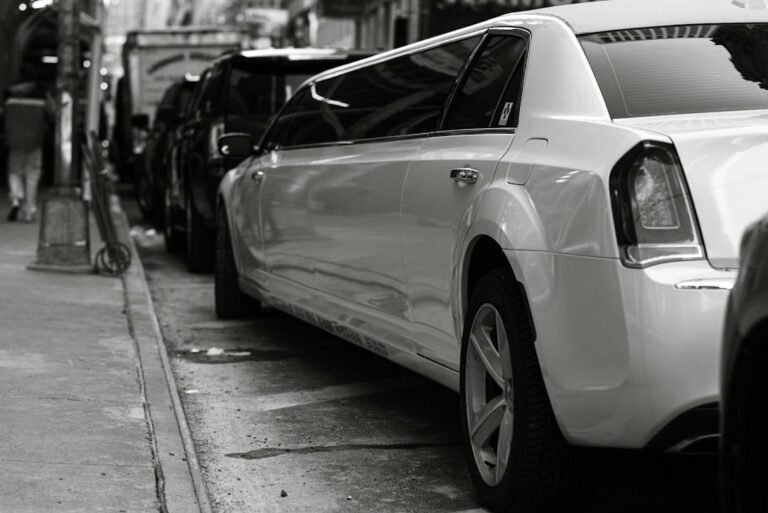
| Celebratory or social groups | Stretch limo or party bus | Client entertainment, incentive evenings, after-event outings |
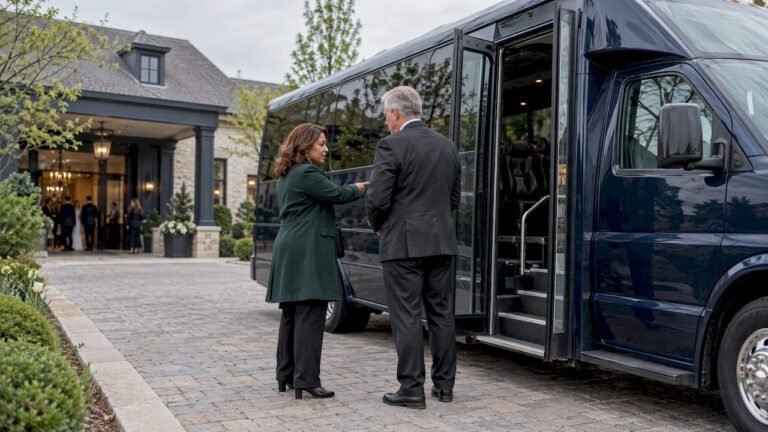
| Large groups | Coach bus | Conference shuttles, whole-company outings |
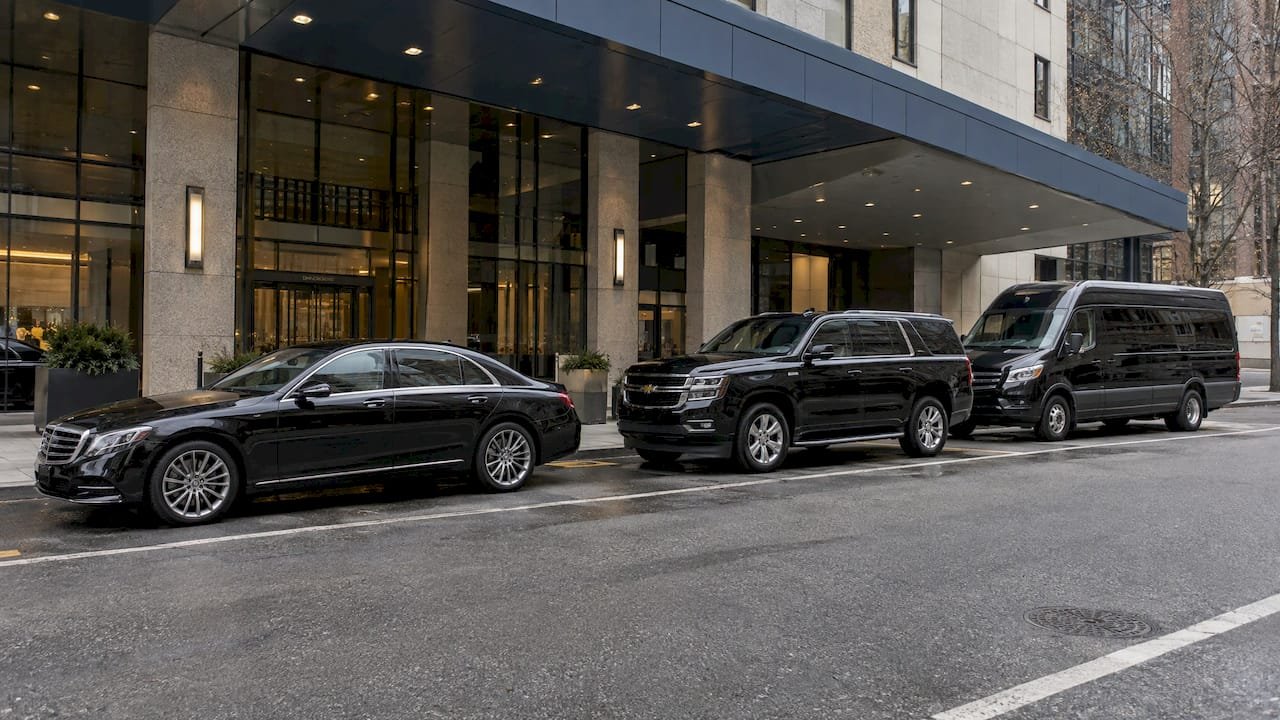
Our fleet includes executive sedans, SUVs, stretch limos, Sprinter vans, party buses and coach buses, so one provider can cover the whole range of an event. You can see the vehicles on our fleet page.
Mixing vehicles in one event
Most corporate events are not one group. A typical day might need a sedan for the keynote speaker, an SUV for two board members and a Sprinter for the sales team. Splitting by role avoids the common mistake of putting everyone in one large vehicle and forcing the most senior guests to wait for the slowest arrival.
Luggage and equipment
Ask attendees whether they travel with checked bags, sample cases, display materials or presentation equipment. Tell your provider the answer before choosing the vehicle. Luggage is the most common reason a group needs a larger vehicle than headcount alone suggests.
Coordinating pickups and routes so the event stays on time
On-time events are made in the spreadsheet, not on the road. A workable coordination plan has five parts.
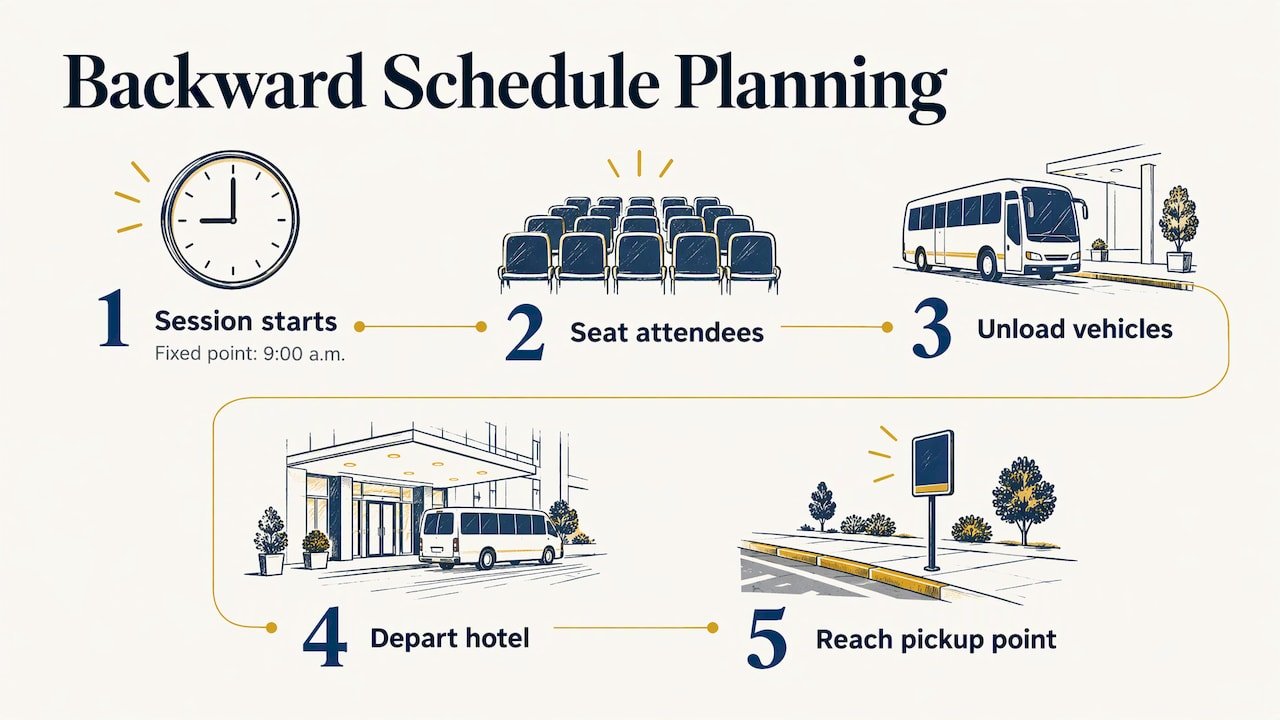
Build the schedule backwards
Start from the fixed point, such as the 9:00 a.m. session start, and work backwards: when attendees must be seated, when vehicles must unload, when they must depart the hotel, and when they must be at the pickup point. Add buffers at each step. Toronto traffic and the Niagara Falls tourist season both make tight schedules fragile.
Use one master manifest
Keep a single document listing each passenger or group, their flight number and arrival time, the pickup location, the destination, the vehicle assigned and a mobile number. Share it with the provider and one named on-site contact. Changes go into the manifest, not into scattered messages.
Agree pickup points in advance
At airports, confirm exactly where chauffeurs meet passengers and how guests will recognize them. At hotels, agree the door or loading zone. At venues, confirm where large vehicles may stop and whether there is a time limit. Our chauffeurs are local, so they know the area’s venues and access points, which helps when a pickup spot is not obvious.
Track flights, not just times
Give your provider flight numbers rather than only scheduled arrival times, so pickups can follow real arrivals. For groups landing on different flights, decide in advance whether guests wait for a shared vehicle or travel individually. A shared transfer saves money but costs the first arrival some waiting.
Set a frequency for shuttle loops
If you run a loop between a hotel and a venue, choose a fixed interval and tell attendees. Predictable departures, with clear signage and one person at each stop, beat “the van will come when full.”
For airport legs specifically, see our airport limo service.
Cross-border guests: what to confirm early
Niagara events regularly involve guests, speakers or clients crossing between Canada and the United States. Documents are the organizer’s blind spot, because a vehicle cannot fix a missing document at the border.
-
Flying in from abroad. Per Immigration, Refugees and Citizenship Canada, visitors who need an eTA must apply online before travelling to Canada by air. It is best to apply before booking the flight, and in most cases approval comes within minutes. Send this reminder in your pre-event email.
-
Business visitors generally. The same IRCC page for event organizers is the place to check what applies to foreign guests attending a conference or meeting in Canada.
-
Carriers and documents. The Canada Border Services Agency states that transporters must not carry to Canada any person who does not hold the prescribed documents. Failure can bring an administration fee and, in exceptional circumstances, seizure of a transporter’s vehicle. This is why we ask organizers to confirm that cross-border passengers have the right documents before the trip.
Practical steps: collect each guest’s citizenship and intended entry method early, remind them to carry original documents in hand luggage, and tell your provider which passengers are crossing so the pickup and drop-off points suit the route. Border rules and wait times change, so check the official government pages close to the event date rather than relying on an older checklist.
What to confirm before you book
A provider can only be as accurate as the brief it receives. Before requesting a quote, have these answers ready:
-
Dates and hours. Start and end times for each leg, plus any likely overrun.
-
Headcount, with a margin. Confirmed numbers and the range you might reach.
-
Pickup and drop-off addresses. Including terminals, hotel entrances and venue loading zones.
-
Flight details. Airline, flight number and arrival time for every airport pickup.
-
Luggage and equipment. Bags per person, plus any cases or displays.
-
Accessibility needs. Mobility requirements for any passenger.
-
Who is the on-site contact. One person with a phone who can approve changes.
-
Cross-border passengers. Who crosses, and in which direction.
-
Billing. Who is invoiced, and whether you need a single invoice for the whole event.
If you can send this list with your request, the quote comes back faster and the chance of a surprise on the day drops.
What affects the cost, and when to book
We do not publish fixed prices, because corporate programs vary too much for a single rate to be honest. We prepare tailored quotes instead. The factors that move a quote are the same ones that shape your plan:
-
Vehicle type and number of vehicles. A coach bus and a sedan are different services.
-
Hours of service. A set transfer differs from time held on an hourly basis. For open-ended days, our hourly service fits better than a point-to-point price.
-
Distance and route. Toronto to Niagara Falls is a different job from a short hotel loop, and a cross-border leg adds its own requirements.
-
Timing. Peak tourist weekends in Niagara and busy conference weeks in Toronto tighten availability.
-
Waiting time and extras. Long waits between sessions, or additional stops, change the total.
As for timing, book as soon as dates and headcount are reasonably firm. Larger vehicles and multi-vehicle programs have fewer options on busy dates, so earlier is safer. You can adjust numbers closer to the event with your provider; securing the vehicles first is the point.
Backup plans that keep the event running
Things go wrong at events: a flight lands late, a session overruns, a road closes. Good planning treats these as expected.
-
Flight delays. With flight numbers on the manifest, your chauffeur can adjust the pickup. Decide in advance how long a vehicle waits before a guest is reassigned.
-
Traffic. Include buffer time on every leg, and keep the most important pickups, such as the keynote speaker, earliest in the schedule.
-
Overruns. Agree what happens when a session ends late: does the vehicle wait, or does the group split? Hourly service handles overruns cleanly.
-
Headcount changes. Keep one spare seat’s worth of capacity in the plan, or know how quickly your provider can add a vehicle.
-
Reachability. Share a 24/7 contact for the day. We operate with 24/7 availability, so an organizer can reach us when an event runs into the evening or starts at dawn.
-
Communication. Send attendees a one-page sheet with pickup times, locations, vehicle descriptions and a phone number.
Write these decisions into the plan, not in someone’s head. Nobody makes good calls about reassigning cars at 6:40 a.m. while a group waits at arrivals.
Beyond the meeting: events with a social side
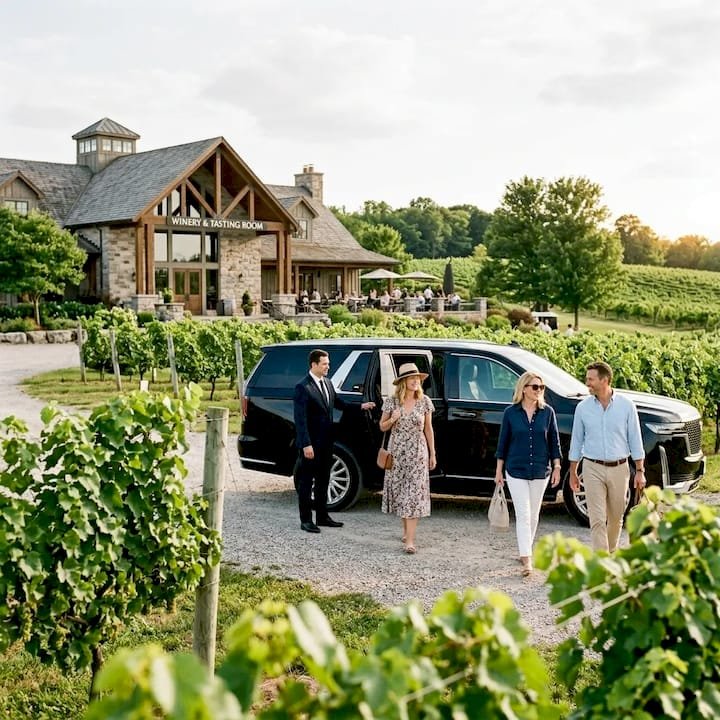
Many corporate programs include time away from the conference room. A group outing to the vineyards of Niagara-on-the-Lake is easier when nobody has to drive; our winery tour limo service is built for that. A client dinner or after-event evening calls for a different tone, and our night out limo service covers it. For smaller executive groups, an SUV or sedan keeps the experience private.
Our perspective on corporate event transportation
We have a simple view: transportation should be the part of your event nobody talks about, because it simply worked.
That comes down to two things we focus on. The first is local knowledge. Our chauffeurs are professionally trained and know Niagara Falls, Niagara-on-the-Lake and Toronto, so they understand which entrances suit which venues and how the area moves at different times of day. That knowledge cannot be added on the morning of the event.
The second is personalization. We do not believe in one template for every corporate client. A board retreat, a sales kickoff and a client dinner have different rhythms, so we shape scheduling and vehicles around yours, from a single executive sedan to a coach bus, and we stand behind punctuality and clean vehicles on every trip.
Our advice to organizers: share the full brief early, give us flight numbers and a named contact, and let us propose the vehicle mix. You will spend your event on your guests, not on logistics.
Andrew
Let us handle the movement plan
We provide executive black car and limousine service for corporate travel, airport transfers, cross-border trips and group outings across Niagara Falls, Niagara-on-the-Lake and Toronto, with local chauffeurs and 24/7 availability. Tell us your dates, headcount and route, and we will prepare a tailored quote.
Start on our corporate travel page, or go straight to the hourly service quote if your program is open-ended.
FAQ
How far ahead should I book transportation for a corporate event?
Book as soon as your dates and approximate headcount are set. Larger vehicles and multi-vehicle programs have fewer options on busy dates in Niagara and Toronto. You can usually refine passenger numbers and flight details later with your provider.
Which vehicle is best for a mixed group of executives and staff?
Use more than one vehicle type. Executive sedans or SUVs suit leadership and speakers, while a Sprinter van or coach bus moves teams together. Splitting by role keeps senior guests on schedule and avoids oversized vehicles for small groups.
What do I need to tell the provider about airport pickups?
Give the airline, flight number, arrival time, passenger names and luggage count for each guest, plus a mobile number for your on-site contact. With flight numbers, the chauffeur can follow actual arrival times if a flight is delayed.
Do cross-border guests need anything special?
They need valid entry documents for Canada. Visitors who need an eTA must apply online before flying, and in most cases approval comes within minutes, according to IRCC guidance for event organizers. Check official government pages close to the event date for current rules.
Sources
-
IRCC: Event organizers and Canadian businesses, bringing business visitors to Canada
-
CBSA: Transportation Company Obligations, Guide for Transporters