

Employee Shuttle Service: How It Works and How to Set One Up
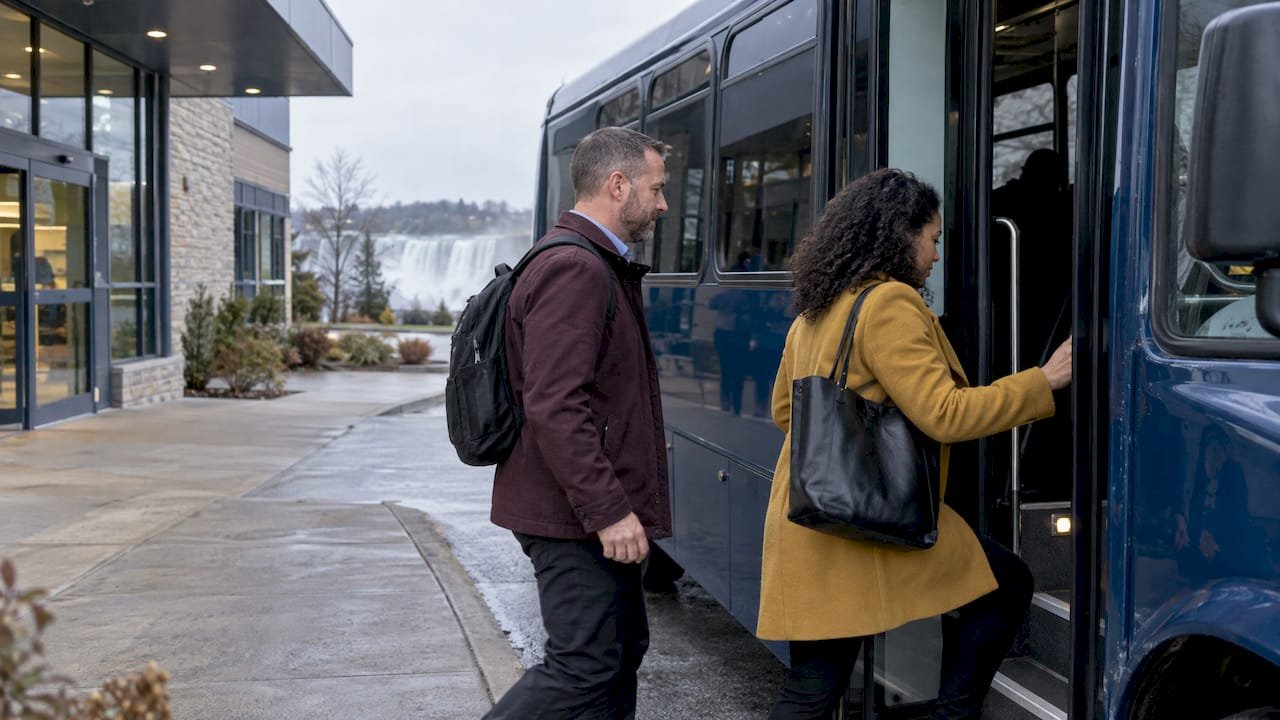
An employee shuttle service is a private, scheduled ride that moves your staff between a fixed pickup point and the workplace, timed to shift starts and finishes. The fastest way to run one well is to hire a local chauffeured operator and size the vehicle to your headcount and shifts, instead of buying vehicles or hiring drivers yourself. At Niagara Falls Limousines, we provide private executive black car and group transportation across Niagara Falls, Niagara-on-the-Lake and Toronto, with sedans, SUVs, Sprinter vans and coach buses, and our local chauffeurs handle the routes and timing you set.
Below you will find what a shuttle program is, how to design it step by step, what Canadian safety rules to keep in view, and how pricing is built.
TL;DR
- An employee shuttle is an employer-arranged service that picks workers up at set stops and brings them to the worksite around shift times. It is not open to the general public.
- Match the vehicle to the headcount: a sedan or SUV for executives, a Sprinter van for small teams, a coach bus for whole shifts.
- Buses with more than 10 seats, driver included, fall under the National Safety Code, so your operator’s vehicles and drivers matter as much as the route.
- Price depends on vehicle type, hours, distance and frequency, so a tailored quote beats a flat per-head guess.
- We build recurring and one-off employee transportation in Niagara and Toronto. Request an hourly quote with your shift times.
Table of Contents
- What an employee shuttle service is
- Who uses employee transportation in Niagara and Toronto
- How to set up an employee shuttle, step by step
- Safety, licensing and insurance in Canada
- How an employee shuttle fits with transit and parking
- What an employee shuttle costs
- Perspective
- Executive and visitor transportation alongside the shuttle
- Get your employee transportation quoted
- FAQ
- Sources
What an employee shuttle service is
The London Transit Commission describes an employment shuttle as a service partnered with an employer: it picks workers up at predetermined stops, sometimes at home, takes them to the worksite entrance and returns them at shift end. It generally runs only around shift starts and finishes and does not serve the general public.
That definition covers a few common formats. Transport Scotland lists home-to-work, last-mile and out-of-hours staff shuttles as the main types. In practice they look like this:
- Home-to-work: pickups in the neighborhoods where your staff live, ending at your gate.
- Last-mile: a loop between a transit station, a parking lot or a GO stop and the workplace.
- Out-of-hours: rides for night shifts, early starts and late finishes when regular transit is thin or absent.
- Inter-site: a shuttle between your offices, plants, warehouses or hotels.
- Executive and client transport: chauffeured rides for leaders, visitors and traveling teams.
The purpose is simple: people arrive on time, rested and without a parking search, and you stop losing the first hour of a shift to traffic, missed buses and no-shows.
Who uses employee transportation in Niagara and Toronto
The Niagara region has a workforce that is spread out and often works unusual hours: hotels and attractions near the Falls, wineries in Niagara-on-the-Lake, manufacturing and logistics along the corridor to Toronto. Many shifts begin before regular transit runs well and end after it winds down. Cross-border employers also move staff and visitors between Ontario and the United States.
Typical employer needs we hear about in this kind of setting include:
- Hospitality and tourism employers moving staff to late or early shifts.
- Offices running a return-to-office schedule with limited parking.
- Companies hosting visitors, auditors or clients who need a polished arrival from the airport.
- Event teams moving staff and guests between venues during conferences and retreats.
How to set up an employee shuttle, step by step
Below is the routine, with where each step tends to go wrong. Where we can take the work off your hands, we say so.
1. Map where your people start and when they need to arrive
Collect home postal codes (the first three characters are enough and keep it anonymous), shift start and end times, and how many people work each shift. Cluster staff by area. A route that picks up from three well-chosen stops usually beats one that tries to reach every home.
Where it goes wrong: surveying only the staff who already struggle. Ask everyone, including drivers’ licence holders who would still ride if the stop were close.
2. Define the shift pattern
A shuttle that runs at shift change only is far cheaper than an all-day loop. The London Transit example shows how tight a workable window can be: a 20-passenger accessible coach in Acheson, Alberta ran weekday mornings from 6:30 to 9:00 and afternoons from 3:30 to 5:30, meeting transit arrivals at both ends. Build your schedule around your own shift starts, and add a buffer of 10 to 15 minutes so one late rider does not delay the whole bus.
Where it goes wrong: setting the pickup at the exact shift start. People then arrive late by design.
3. Match the vehicle to the headcount
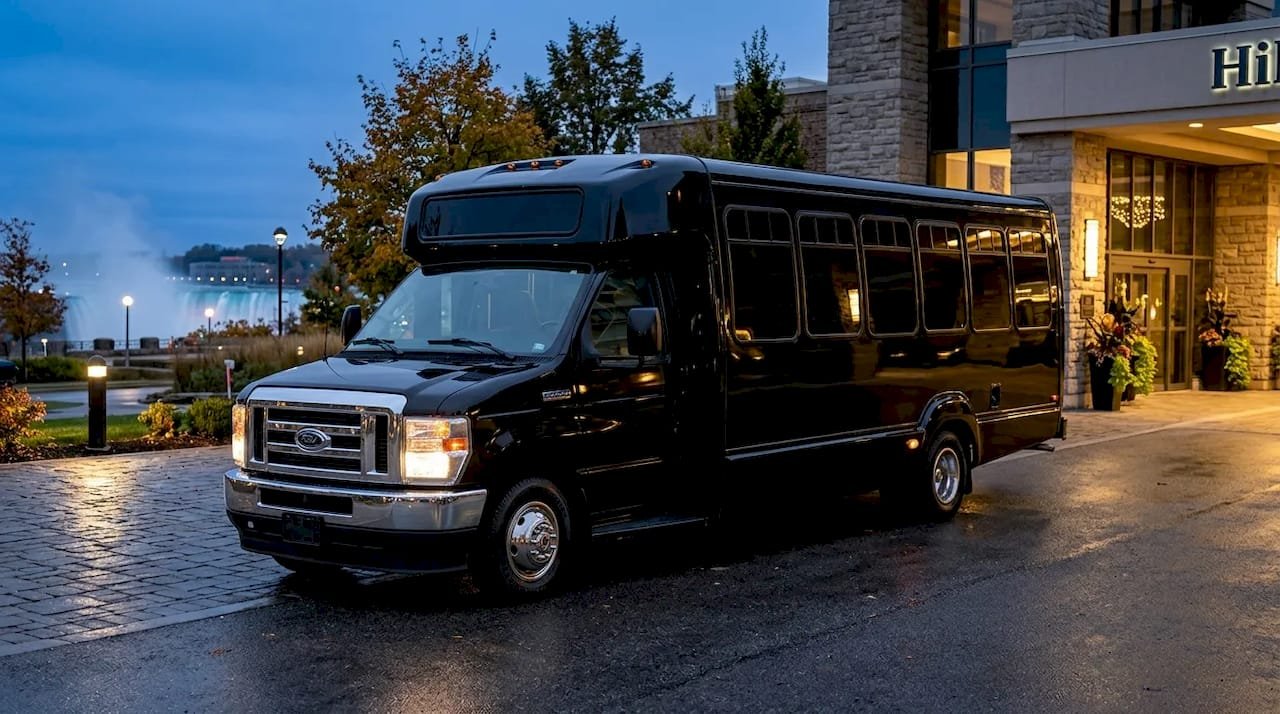
Our fleet covers the range, so you can start small and scale:
| Group | Vehicle type | Typical use |
|---|---|---|
| 1 to 3 | Executive sedan or SUV | Executives, visiting clients, airport pickups |
| Small teams | Sprinter van | Inter-site runs, small shifts, team retreats |
| Larger groups | Party bus or coach bus | Whole-shift runs, conferences, company events |
See the fleet page for the current vehicles. Plan for peak, not average: if 38 people ride on Monday and 22 on Friday, size for Monday or add a second departure.
For reference, one Toronto procurement document for a city passenger shuttle specified vehicles accommodating 70 passengers, backup vehicles and room for up to four wheelchairs. That is a municipal contract specification, not a rule for every employer, but it shows the factors a serious program considers: capacity, a backup vehicle and accessibility.
4. Choose stops and timing
Pick stops that are safe, lit and easy for a bus to enter and leave: a plaza lot, a transit hub, a community centre. Keep the total ride under about 45 minutes where possible, or people will drift back to driving. Publish the schedule in one place and keep it the same every day.
Our chauffeurs are local, and knowing the roads, the construction and the bottlenecks around the Falls, the QEW and Toronto is part of what a shuttle needs to hold its timetable.
5. Check safety and licensing
This is the step that turns a pleasant idea into a defensible program. See the next section for the framework.
6. Decide who pays
Some employers cover the full cost, which makes the ride free to staff, as in the Acheson example where businesses fund the service so riders pay no fare. Others subsidize partly or run it as a perk for night shifts only. Decide early, because it affects how many people sign up.
7. Launch, then adjust
Run a trial period of a few weeks. Count boardings by stop and time, then trim empty departures and add seats where riders were left behind. Recurring service rarely stays identical after the first month.
Safety, licensing and insurance in Canada
Safety is shared between federal and provincial governments. Transport Canada says motor-carrier safety is a joint federal and provincial or territorial responsibility, with the provinces implementing National Safety Code standards and enforcing the legislation.
Key points for an employer hiring a shuttle:
- Vehicle size matters. The National Safety Code applies to buses with a designated seating capacity above 10, including the driver, and sets minimum operational and performance requirements for carriers and drivers.
- Seat belts depend on weight class. Transport Canada’s review states that buses below 4,536 kg GVWR must have seat belts, while heavier buses generally do not require passenger belts except at the driver’s position. Requirements vary by vehicle classification, so never assume two buses are equipped the same way.
- Who enforces what. Federal standards address vehicle requirements such as braking and emergency exits, while provinces and territories enforce road rules and set licensing and operating requirements.
- Driver conduct. Ontario’s Commercial Vehicle Operators’ Safety Manual covers speed limits, seat-belt use, impaired driving, defensive driving, fatigue management, load security and bus emergency exits.
- Crossing provincial lines. The federal Motor Vehicle Transport Act requires an extra-provincial carrier to operate under a provincial safety fitness certificate or an analogous prescribed document. That is relevant if your route runs between provinces.
For insurance and your own workplace obligations, such as how a commute is treated under your workplace safety coverage, speak with your insurance broker and your provincial workers’ compensation board. Hiring a professional operator puts the vehicles, chauffeurs and driving hours in the hands of a business that does this daily, rather than adding them to your own payroll and risk register.
How an employee shuttle fits with transit and parking
A shuttle works best as a connector, not a replacement for everything. The Acheson service is a good model: morning departures coincided with arrivals of Edmonton Transit, afternoon trips returned workers to the same stops, and employers funded it. The shuttle solved the last few kilometres that transit could not.
Three combinations tend to work:
- Transit hub to worksite. Staff ride GO or regional transit to a station and take your shuttle for the last leg.
- Remote lot to worksite. If parking is scarce, a shuttle from an overflow lot frees up space and removes the daily search.
- Night-shift door-to-door. When transit stops running, a scheduled pickup is the difference between a role being filled or not.
What an employee shuttle costs
There is no honest flat price for “a shuttle”, because the bill follows a few variables:
- Vehicle type: a sedan, a Sprinter van and a coach bus are priced differently.
- Hours and distance: a short loop at shift change costs less than an all-day circuit.
- Frequency: daily recurring service is planned differently from a one-off event.
- Timing: early mornings, nights, weekends and holidays can change the quote.
- Waiting time and extra stops: a second pickup or a long wait at the plant gate adds hours.
Because the cost is driven by the vehicle and the hours, it is usually quoted per vehicle and per service period, not per employee. That makes a full bus much cheaper per rider than a half-empty van. Our quotes are tailored to your route and schedule, and we offer hourly service so you pay for the time you actually need. We do not publish a flat rate, so send us your shift times, pickup areas and headcount and we will price it for your case.
Perspective
Most employers come to us after a rough month: late arrivals, a lot full by 8:15, or a night shift that cannot find a ride home. The fix is rarely complicated. It is a reliable vehicle, a driver who knows the roads, and a schedule that does not change without notice.
That is what we are set up to provide. Our chauffeurs are local professionals with real knowledge of Niagara and Toronto, our vehicles are kept clean, and punctuality is the promise we make to every client. We are available 24/7, which matters for early starts and late finishes, and we tailor each plan to the schedule and group size in front of us, from one executive in a black car to a full coach.
If you are weighing whether to run transportation yourself, think about what you would take on: vehicles, drivers, backup cover, licensing, scheduling. A dedicated operator carries all of that so your managers can run the business.
Andrew
Executive and visitor transportation alongside the shuttle
Most employers need more than a staff loop. The same operator can handle the rides around it:
- Executives and visiting clients arriving by air: our airport limo service covers pickups and drop-offs.
- Client entertainment and team celebrations: a night out or a winery tour for a team reward.
- Business travel across the border: our cross-border and corporate travel service.
One provider across all of these means one point of contact and one standard of service.
Get your employee transportation quoted
If you have a headcount, a shift pattern and a worksite, you have what we need. We will recommend the right vehicle, set the pickup times and quote the service for your route. Our team works across Niagara Falls, Niagara-on-the-Lake and Toronto, with chauffeurs who know the area.

Request a tailored quote with your shift times, pickup areas and group size, or reach us through the main site.
FAQ
What does a staff shuttle service mean?
It is a scheduled ride arranged by an employer to carry workers between pickup points and the workplace, usually timed to shift changes. It is for employees only, not the general public. It can run from homes, transit stations or parking lots.
How much does an employee shuttle cost?
It depends on the vehicle, the hours, the distance and how often it runs. Quotes are usually built per vehicle and service period, so a full vehicle lowers the cost per rider. We prepare a tailored quote from your route and schedule.
How does a shuttle service work day to day?
You share shift times, pickup stops and headcount. The operator assigns a vehicle and a chauffeur, who run the agreed loop at set times. You review ridership after a trial period and adjust the stops or departures as needed.
What is the purpose of an employee shuttle?
It gets staff to work on time without parking or traffic stress, and it fills gaps where transit does not run at shift hours. For employers, it improves punctuality and helps with hiring for early, late and night shifts.
What size vehicle do I need?
A sedan or SUV suits a few executives, a Sprinter van suits a small team, and a coach bus suits a full shift. Plan for your busiest day. Note that buses with more than 10 seats including the driver fall under the National Safety Code.
Sources
- Industrial Service Survey Results, London Transit Commission
- Staff Shuttle Bus, Transport Scotland
- Attachment 1: Major Terms and Conditions of the Agreement, City of Toronto
- Commercial vehicles safety in Canada, Transport Canada
- Occupant Protection in Buses: A Brief Review, Transport Canada
- Evidence, TRAN (42-1) No. 136, House of Commons
- Commercial Vehicle Operators’ Safety Manual, Ontario
- Motor Vehicle Transport Act, RSC 1985, c 29 (3rd Supp)